 Star-shaped micelles
Introduction
It is an honor to see you are interested in this work. The abstract below is the one presented for this study. Questions are welcome at sahranavard.mehrdad@gmail.com.
The use of the potent antineoplastic agent camptothecin for colorectal cancer, the third most common cancer type in the world, has been limited by instability and low solubility of the active form, together with severe adverse effects. Targeted star-shaped micelles can reach tumor cells and offer a delivery system with a low critical micelle concentration and high thermodynamic stability, avoiding the delivery drawbacks of hydrophobic agents such as camptothecin.
This work synthesized and characterized an epithelial cell adhesion molecule (EpCAM) targeted star-shaped polylactic acid (PLA)–polyethylene glycol (PEG) copolymer to deliver camptothecin to colorectal tumor cells, and assessed the formulation in vitro and in vivo.
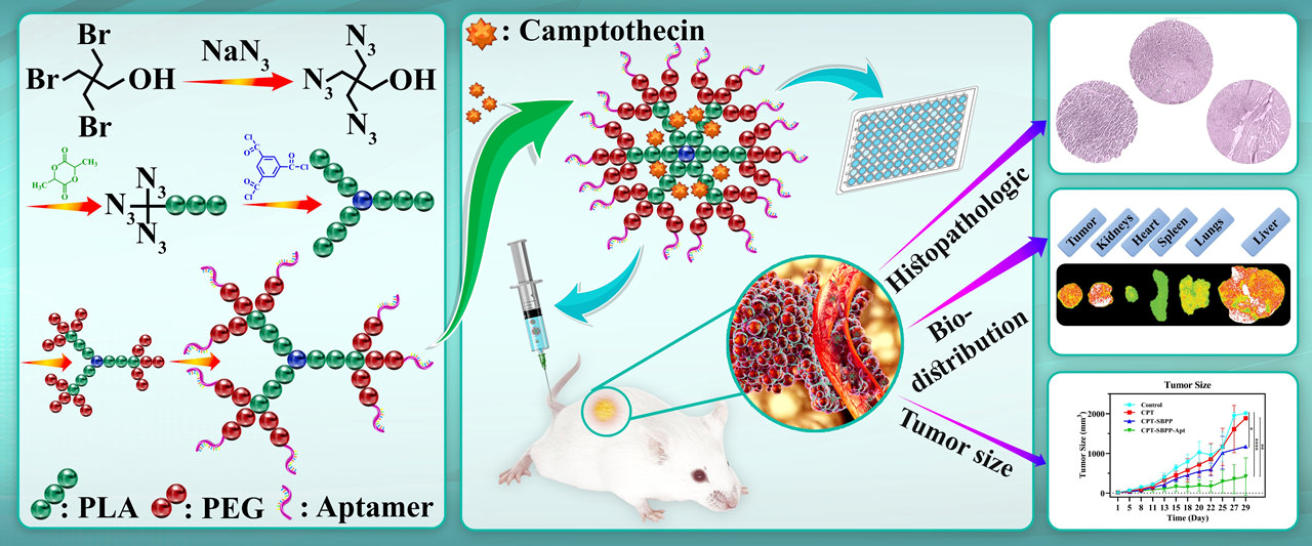
Material and methods
3-Azido-2,2-bis(azidomethyl)propan-1-ol was synthesized and used as the initiator of PLA synthesis by ring-opening polymerization. Three PLA molecules were conjugated with 1,3,5-benzenetricarbonyl trichloride, and three alkyne-PEG-maleimide molecules were conjugated to the end of each PLA chain by click reaction. The maleimide terminal of PEG was used to attach the EpCAM targeting aptamer.
Synthesis steps were confirmed by 1H nuclear magnetic resonance, gel permeation chromatography, and differential scanning calorimetry. Loading and release profiles, and the size distribution and shape of camptothecin-loaded copolymeric micelles, were studied by dynamic light scattering and by scanning and transmission electron microscopy. In vitro studies used the C26, HT29, and CHO cell lines, followed by in vivo tumor-suppression efficacy, biodistribution, and histopathological evaluation.
Results
Analysis showed that the copolymer had been synthesized as intended. Targeted camptothecin-containing micelles were spherical, with a diameter of 192 nm. The polydispersity index was 0.2, and the zeta potential was −17.3 mV. Camptothecin loading content was 3.7±0.4, and encapsulation efficiency was 73.7±8.2.
In vitro assays showed significantly higher dose-dependent cytotoxicity for the targeted formulation, then the non-targeted formulation, compared with free drug on C26 and HT29 cells. No significant difference was found on the CHO cell line. In vivo, targeted camptothecin copolymeric micelles suppressed tumors more effectively than the non-targeted micelles and the free drug. Biodistribution showed a significantly higher entrance of the non-targeted formulation into the tumor after 6 hours, and a significantly higher entrance of the targeted formulation after 18 hours.
Discussion
A size below 200 nm suits the enhanced permeability and retention (EPR) effect. The EpCAM targeting aptamer appears to explain the higher cytotoxicity of the targeted micelles in cancer cell lines, while receptor-mediated endocytosis is the reason for the higher cytotoxicity of the non-targeted micelles in those lines. The lack of a significant cytotoxicity difference in the normal cell line indicates efficient targeted delivery.
Higher distribution of the non-targeted formulation in tumor tissue after 6 hours is consistent with the EPR effect, while the higher distribution of the targeted formulation after 18 hours is consistent with EpCAM targeting.
Conclusions
The analytical results make this nano drug-delivery system a good candidate for targeted delivery of hydrophobic agents, and they raise hope for overcoming the clinical drawbacks of camptothecin.